
We are committed to sharing news, stories, events and opinions that ensures our province stays free, united and independent from the overreach of the Federal government.
All are welcome and respectful debate is encouraged. Please join with the intention of participating. Proceeds are donated.

This was in my in-box this morning- will go through as the media is not helping us decide!
October 19 is coming soon, and while Question 10 is getting a lot of attention, we know people like you are taking a look at the other 9 as well.
This email goes into why we think you should vote YES to all 9. We’re hoping not only that you agree, but that you’ll take the time to share these points with your friends and neighbours now that it is on people’s minds.
Open border immigration policies by the Trudeau-NDP alliance in Ottawa put irresponsible strains on our social services, housing, and employment.
They doubled, and then tripled the number of immigrants, and every province was left with the fallout of larger classrooms and busier ERs.
Immigration is shared jurisdiction between provinces and Ottawa, and we need to take steps to gain the kind of control over immigration that Quebec has.
You can help.
In the October 19 referendum, say YES to questions 1-5 to support our efforts to determine who and how many people immigrate to Alberta, and how temporary residents use our social services.
Question 1 asks if we should have more control over immigration. If we could recruit and vet the immigrants approved for Alberta (like Quebec does), we could ensure the numbers were sustainable and that there was a genuine economic need. We could verify that there are not enough underemployed Albertans to fill the positions.
Ensuring we have jobs available for immigrants and temporary residents is a win for Albertans and a win for the immigrants.
Question 2 outlines one tool we could use to gain better control – certifying the temporary residents we agree are needed, and not offering provincial funded services to those we do not.
Questions 2-4 explicitly do not change anything for citizens or permanent residents, and the vast majority of new Canadians are in these two groups.
But international students and workers are different. They are already not eligible for most social support programs like AISH and basic welfare. Lower eligibility for programs for international visitors is true in every province and was true in Alberta under the NDP. The question is whether we should shift the line.
Temporary residents are mostly here on a temporary visa to study or work. We value their contributions, especially the Temporary Foreign Workers (TFW) filling important gaps in our economy.
But they have already agreed to go home when their visa expires. If their work or study falls through or the season ends, they are expected to leave.
Offering world class health care and education to temporary residents is a choice. It incentivizes some to bring their families for the few years they will be here. It makes others want to stay longer than they might have if their job isn’t working out.
Question 3 looks only at social services that are not education or health care and asks if a 12 month or longer waiting period should apply before temporary residents are eligible for things like our very in-demand child care subsidies.
Question 4 asks if temporary residents should pay a reasonable fee to get health insurance or send their kids to schools.
Each student effectively comes with a $13,000 grant paid by the province and your education property taxes.
With over 45,000 children of temporary residents in our K-12 schools, that’s a $600 million bill each of the last few years. That doesn’t even include the capital costs of our school buildout to try and keep up with the sudden growth. (45,000 kids fills about 80 schools).
Visiting workers paying a nominal fee won’t cover that expense, but it will recover some of it and make others reconsider whether to bring families here temporarily or not.
Health care costs were tracked by residency status and TFWs and international post-secondary students alone had a $400 million share of the costs in 2024, including 30,000 ER visits.
To get health insurance in the UK, visiting students pay about $1400 and workers $1900 per year before they even arrive. Albertans used to all pay a health premium that was the equivalent of about $950 per person or $1900 for a family today.
If you think something in the range of those numbers would not be too much to ask of visiting workers and students to get health coverage (or get their own insurance) then vote YES to question 4.
Question 5 asks if we should show proof of citizenship to vote. It is already the law that you must be a citizen, but Elections Alberta does not ask for proof beyond signing an oath. Alberta drivers licenses now add an indicator for Canadian citizenship, but various forms would be accepted.
Constitutional
Questions 6-10 are proposals to change the constitution that emerged from our Alberta Next Town Hall process. Immigration was the top concern, thus the first section of the referendum.
There was a consensus that Ottawa was overstepping in many ways that were not in the spirit of the constitutional bargain provinces made in creating Canada. While wholesale constitutional change was considered unlikely, some targeted changes might succeed and restore or enhance the autonomy provinces have.
A positive vote on these 4 questions will give our government a mandate to get other provinces and Canadians on board and pressure the federal government to make changes that will give all provinces more sovereignty within a united Canada.
Question 6 asks if we should appoint the Judges to Alberta’s higher courts. Constitutionally, this is a federal power.
Alberta already has an independent process for appointing Justices of the Peace and Judges of the Alberta Court of Justice.
But unlike in federated countries like Germany and Australia, our Court of King’s Bench and appeals court are appointed by the federal government.
So the federal government decides criminal law, then appoints the Judges for all the controversial and complex cases, as well as the Judges on the Alberta Court of Appeal.
The federal government has the power to appoint the Supreme Court. That is an adequate safeguard.
Vote YES to question 6 if you think provinces should be in charge of filling the benches of their courts that so Judges reflect the values of the people they serve.
Most if not all provinces will be eager to join us in pressing Ottawa for change.
Question 7 asks if Albertans want to eliminate the Senate.
Alberta and British Columbia each have only six Senate seats, while the four Atlantic provinces collectively have 30 despite having only 2.5 million people.
We’ve tried reforms for a generation, it has obviously failed when you consider Trudeau’s appointment of the likes of Paula Simons and Kristopher Wells over the nominees we democratically elected in 2019.
The Senate is a patronage house that provides little democratic accountability and delivers limited value to Canadians.
With 80% of our current Senators appointed by Trudeau, we really don’t want them using their powers anyway.
This proposal will be harder to convince all provinces on, but vote YES if you’d like to see us push to just abolish the expensive, unfair, and unelected Senate before it does any more damage.
Premiers and provincial legislatures, not the Senate, are the most effective regional check on federal power. Their authority should be strengthened.
That’s what the last two Constitutional questions in our referendum would do.
Question 8 seeks an “opt-out with compensation” provision for federal programs that go into provincial jurisdiction.
Too often, Ottawa creates national programs in areas that are clearly provincial responsibilities and then expects provinces to redesign their systems around federal priorities.
Think of examples like childcare, school lunch programs, pharmacare, and dental care. Square shaped federal programs being jammed into rounded provincial ones.
Albertans do not need federal politicians making decisions on their behalf in matters of provincial jurisdiction. Those choices belong to Albertans and the government they elect, not to bureaucrats and politicians 3,000 kilometres away.
If Ottawa wants to support these priorities, then write the cheque and get out of the way.
Don't force provinces to contort effective, locally designed services to comply with a federally prescribed model. Alberta's needs are not identical to those of every other province, and our solutions shouldn't have to be either.
Quebec has secured arrangements like this from Ottawa in the past. It's time to make that principle available to every province, not just one.
Such an approach would serve as a meaningful check on federal overreach.
If provinces could opt out with full compensation, Ottawa would have a much stronger incentive to work collaboratively with provinces rather than imposing one-size-fits-all national programs.
This is an idea that already has support among premiers across the country, regardless of political stripe.
Every province benefits when jurisdiction is respected and decisions are made by the governments closest to the people they serve.
Question 9 seeks to give provinces paramountcy when laws in our jurisdiction conflict with federal laws. This would also be a major check on federal interference, particularly on resource development.
The Constitution does not say federal laws override provincial ones when there is conflict. That doctrine was developed through court decisions, not negotiated by the provinces that entered Confederation.
This proposal would place that clarification directly into the Constitution. We would still want Ottawa to be able to overcome barriers to inter provincial projects in the national interest – that was one of the big reasons for Confederation in the first place.
But clear areas of provincial jurisdiction are important – provinces insisted on maintaining them for good reasons - and in general the onus should be on Ottawa to prove that its competing law should override provincial ones, not the other way around.
If provincial jurisdiction on resources, electricity, agriculture, property, policing, and business licensing, took precedence over whatever latest scheme Ottawa cooked up, Canada would be in a much stronger position.
Help us send a message to Ottawa by sharing these points and encouraging your friends and neighbours to vote YES to questions 1-9.
Polling stations will be set up like a regular election on October 19, and early voting will also be available on October 13-17. For more information go to Elections Alberta’s website.

Use these discount codes to get 1/2 price subscription.
Monthly FREEALBERTA -$1
Annual GWDISCOUNT- $12
Renewing subscription to pay direct and take advantage of the discount. Go to "contact us" the option to pay by credit card shows up and you can renew using the codes.
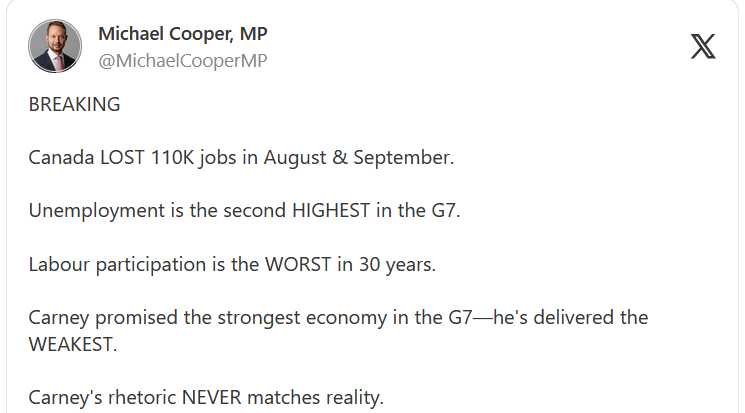
Canada bleeds 110,000 jobs in two months as unemployment hits 6.5%
Young Canadians were among the hardest hit, accounting for 67,000 job losses over August and September combined.
Canada shed 68,000 jobs in September, bringing losses over the past two months to 110,000 as unemployment climbed to 6.5 per cent, according to Statistics Canada.
The latest Labour Force Survey, released Friday, showed the second consecutive month of employment declines, following 42,000 jobs lost in August.
The September figures were far worse than economists expected. Forecasters had anticipated 9,200 new jobs, missing the actual result by more than 77,000 positions.
42,000 jobs lost in August: StatsCan
Full-time employment fell by 35,000 positions, while part-time employment declined by 33,000.
Public sector employment dropped by 70,000 positions, its fourth consecutive monthly decline, while self-employment fell by 23,000. Private sector employment was little changed.
Young Canadians were among the hardest hit, accounting for 48,000 job losses in September. Another ...
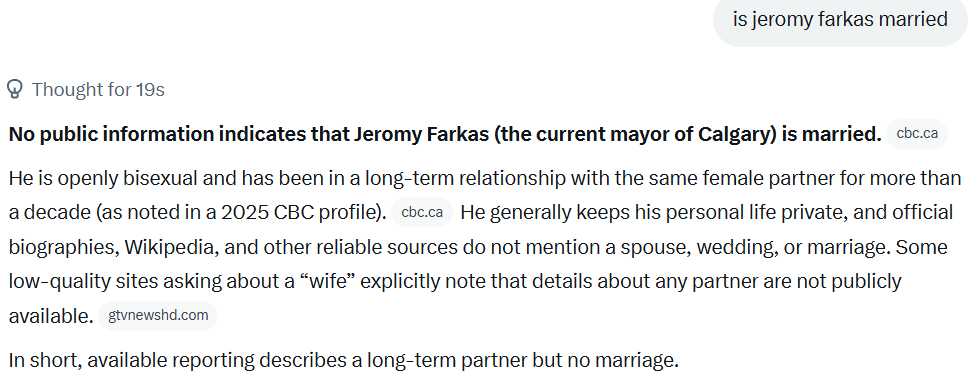
Today I asked 2 AIs (Grok & Duck.ai) if Jeromy Farkas is married. Duck.ai said it couldn't find reliable information whether JF is married. When I pushed a little, I got a rather superior comment that public figures don't always share details about their relationships, ending with the comment that Duck.ai "shouldn't guess" .
Grok, however, found a different story: JF says he's openly bisexual and has been in a 10+ year relationship with the same female partner.
So I went back to Duck.ai with Grok's info, who then changed its tune and agreed with Grok's info, saying "You're right - my earlier answer was incomplete." I asked if someone else makes this same enquiry, will Duck.ai now provide this answer to them. Short answer: No.
Then I asked: If people like me provide a correction but you don't update your sources how can anyone rely on your replies as accurate?
Duck.ai said: That’s a fair concern. You shouldn’t treat my answers as automatically authoritative.
Me: So you're saying...