
We are committed to sharing news, stories, events and opinions that ensures our province stays free, united and independent from the overreach of the Federal government.
All are welcome and respectful debate is encouraged. Please join with the intention of participating. Proceeds are donated.

Post by Michael Wagner
Although this writer opposes Alberta independence, his recent National Post column provides an excellent summary of why many of us want Alberta out of Canada:
How the Liberals turned an alarming number of Albertans into separatists
By Carson Jerema, National Post
Published May 06, 2026
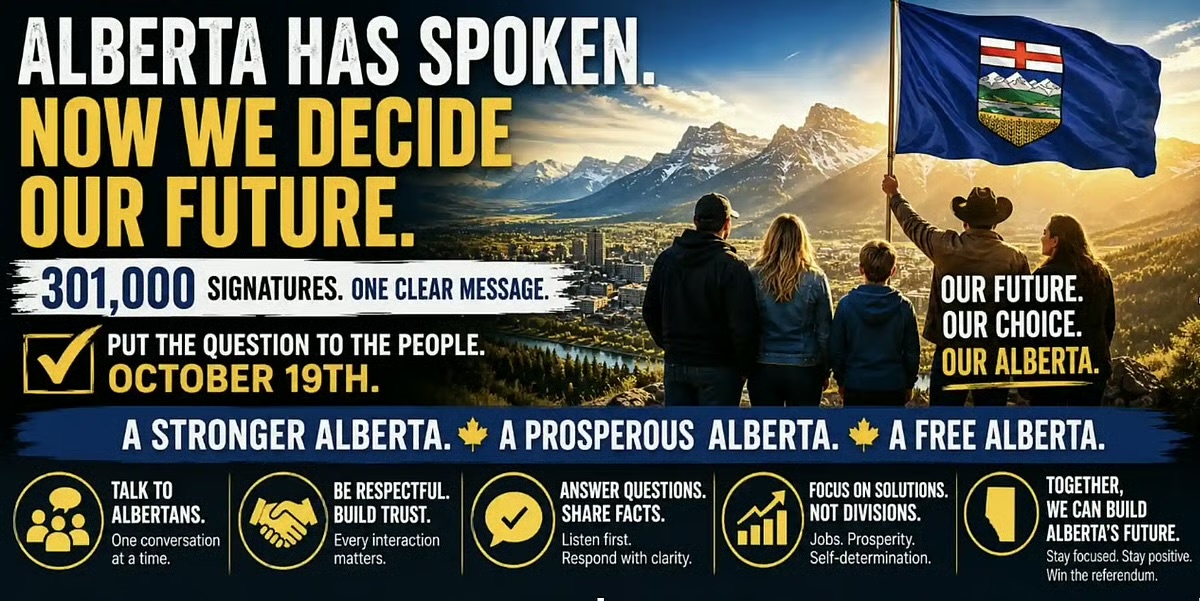
EDMONTON — Instead of expending all his efforts trying to integrate into Europe, perhaps Prime Minister Mark Carney could focus on clearing the tinder that is about to ignite a raging fire of anger in the West. Every time the Liberals dismiss Alberta, bring in new policies to control its resources, or ignore or try to manipulate the constitution against the provinces, it motivates the separatists, who on Monday delivered a petition for an independence referendum with more than 300,000 signatures. We are now very likely to get such a vote this fall.
This is the fruit of a decade of Liberal governance that has cracked and divided this country in possibly irreparable ways.
On every economic indicator that matters, things have gotten worse for all of Canada, but specifically for Alberta. Whether standard of living, business investment, bankruptcies, wage growth, all have either worsened or slowed under the Liberals. The crash in oil sector investment may be, as Liberal defenders keep trying to insist, simply the result of market realities, starting with when the price of oil began dropping in 2014, or a reflection of a mature industry that doesn’t need more investment. But if that were true, there is no way to tell, because the government has suppressed market signals through high taxes and endless regulatory burdens and review processes. The same people who say there is no business case for new energy infrastructure are often the most vocal advocates of using regulation to kill any such business case.
For Albertans, this has meant lower wages and less stability. While the province continues to perform economically better than much of the rest of the country, that is a testament to how much worse things could get, not how good things are.
Ottawa’s attempt to reconcile with Alberta is little more than a finger in the eye itself. The memorandum of understanding signed by Carney and Alberta Premier Danielle Smith promised a deal to approve a pipeline, but already blew right past its April 1 deadline. The MOU places onerous burdens on any plan to build a pipeline by tying it to a massive carbon capture and storage project and giving the anti-energy B.C. Premier David Eby an effective veto. Tell me again about how limited private interest in energy infrastructure is merely a business decision.
It is, in fact, a political decision to repeatedly target a specific region of the country for economic punishment. Whatever legitimate concerns may exist over the environment, the singling out of the West fits within Canada’s history of being governed largely for the benefit of Ontario and Quebec, with minimal concern for other regions.
The Liberal regime of the Impact Assessment Act, west coast tanker ban and carbon taxes shares a pedigree with Canada’s long tradition of anti-Western policies. John A. Macdonald’s National Policy protected central Canadian industry, thereby forcing western farmers to buy machinery at inflated costs while competing unprotected on world markets; Alberta and Saskatchewan, given provincehood in 1905, were not granted control over natural resources until 1930, and Pierre Trudeau’s national energy program kept oil prices artificially low, depriving western oil producers profits to benefit oil consumers east of Manitoba.
The Liberals’s environmental agenda is merely the latest iteration of a dynamic that goes back to Confederation, if not before. The population differences between the West and Central Canada mean that any election will be decided before votes are counted in Alberta. You might say, well, that is representation by population, but, unlike in other federations, there is no effective regional counterbalance. Not only does the Senate lack democratic legitimacy, it is also heavily weighted towards Quebec and Ontario, which each get 24 seats, while the western provinces each get six. Nova Scotia and New Brunswick each get 10 seats.
Even constitutional provisions intended to protect the provinces are disregarded when the interests of Alberta are in play. Section 92A grants provinces exclusive control over the exploration, development and taxation of natural resources, meaning Trudeau’s carbon-tax regime was blatantly in contravention of the Constitution. Yet the Supreme Court upheld it in 2021, an outcome that was comically lawless. Later in 2023, the Supreme Court ruled against Ottawa and struck down the Impact Assessment Act. No matter, the Liberals kept the law in place with only minor and insufficient changes.
To be clear, I do not support separation. I am not allured by the prospect of living in a landlocked Alberta with a small population that would be easily subject to foreign manipulation, and would just as easily be susceptible to the radical progressive agenda that has brought us to this point. I also think that Canada, despite its flaws, is worth the effort to fix. Our Constitutional monarchy and decentralized federation are uniquely equipped to underpin a land of liberty, but that is a column for another day.
When considering the last 10 years, and the internal structures that incentivize Ottawa to exploit the West, and Alberta in particular, the fact that support for separation hovers in the polls around 30 per cent is hardly surprising. The Carney government should take this seriously, and in a way that goes far beyond the MOU signed with Smith. Today, the separatist movement is divided with multiple factions and competing objectives, with no clear leadership, some of whom are facing potential legal problems over the unauthorized distribution of voter lists.
And yet, their cause has the support of one third of Albertans. Imagine what happens if they ever become organized.