
We are committed to sharing news, stories, events and opinions that ensures our province stays free, united and independent from the overreach of the Federal government.
All are welcome and respectful debate is encouraged. Please join with the intention of participating. Proceeds are donated.

Sad. But really I shouldn’t be surprised. Now, will we see a retraction?
Canadian scientific journal failed to indicate 138 of its reports were fictional
The case of "Baby boy blue," published in the Paediatrics & Child Health journal, was admitted to be fictional a decade after publication — and the admission led to 137 others being classified the same way.
Paediatrics & Child Health
Paediatrics & Child HealthChatGPT
Leah Mushet
Leah Mushet
Published on:
05 Mar 2026, 9:25 am
A Canadian paediatric scientific journal has admitted to publishing 138 fictional cases — without telling readers.
Paediatrics & Child Health, the journal for the Canadian Paediatric Society (CPS), publishes paediatric cases under its Canadian Paediatric Surveillance Program.
They've been publishing these peer-reviewed cases since 2000, yet somehow forgot to indicate 138 cases were fictional.
According to Retraction Watch, the news came after The New Yorker reported on one of the fictional reports: "Baby boy blue" originally published in 2010, describing a case of an infant who died from opioid exposure.
The infant had been exposed via breast milk, with the mother taking acetaminophen with codeine, which is usually used for short-term pain relief.
The New Yorker revealed the case was fabricated, citing an admission from one of its co-authors, Michael Rieder.
The admission came as a very shocking surprise to David Juurlink, a professor of medicine and pediatrics at the University of Toronto, who had spent over a decade looking into the claim infants can receive a significant or lethal dose of opioids via breast milk when mothers take acetaminophen with codeine.
The first recorded case of an infant dying from a lethal dose of acetaminophen with codeine was in 2006, published in the Lancet by pharmacologist Gideon Koren.
Koren claimed, using the 2006 article for years, that codeine (metabolized into morphine in the body) posed a deadly risk for breastfeeding infants.
Juurlink found this claim made by Koren and two other research papers (now both retracted) to be pharmacologically unlikely.
According to The New Yorker report, a review of the autopsy data from the Lancet article showed the baby had been given the medication directly rather than ingesting through breast milk.
The fictional case in the "Baby boy blue" case was “the only such case study, aside from the Lancet case report and the two now-retracted descriptions of the same case in Canadian Family Physician and Canadian Pharmacists Journal,” stated Juurlink.
“It is the most compelling published description of neonatal opioid toxicity from breastfeeding. And it is wrong."
Rieder admitted to Juurlink it was a fictional report years after the report's publication, in the most casual of ways.
Juurlink had been sharing a taxi with Rieder while attending a professional meeting in Ottawa when Juurlink decided to ask Rieder about the case.
Juurlink, at that point, had been studying the case for a decade and had found no credible case other than the case of "Baby boy blue," of an infant dying from breastfeeding.
“Oh, we made it up,” Rieder told him in the taxi.
According to an email Rieder sent Juurlink a few years later, the "Baby boy blue" case had been made as a "cautionary tale" for teaching purposes.
However, no such disclaimer was ever included in the article.
The consequence of the lack of a disclaimer had a domino effect:
The paper has been cited in at least one court case and in a doctoral thesis.
“Pathologists and forensic toxicologists have come to accept the idea of ‘death by breast milk’ based upon terribly sloppy work that began in Gidi’s lab,” Juurlink wrote to Rieder.
“Experts and the courts are being misled by this belief. Unfortunately, your case work contributes to that misconception.”
Rieder stated the paper would “likely” be updated with a disclaimer in 2024, some fourteen years after it was published, but it was only added as of February 2026.
Juurlink believes the case should not just have a correction added but that the whole report should be retracted.
“The paper should obviously be retracted," Juurlink stated.
“It’s a fictional case portrayed as real and its scientific underpinnings have collapsed, yet it perpetuates them.”
All the 138 reports, now corrected to state they are fictional, have been cited 218 times in different research.
“Based on The New Yorker article, we made the decision to add a correction notice to all 138 publications drawing attention to CPSP studies and surveys to clarify that the cases are fictional,” Joan Robinson, editor-in-chief of Paediatrics & Child Health, told Retraction Watch.
“From now on, the body of the case report will specifically state that the case is fictional.”
In the case of "Baby boy blue," “the article was structured as an authentic clinical case, indexed as such, and cited as an actual clinical observation. Readers had no way of knowing it was fictional,” stated Juurlink.
“A narrative that is fictional but published in the format of a genuine case report, without disclosure at the time of publication, is functionally indistinguishable from fabrication in the scientific record."


Use these discount codes to get 1/2 price subscription.
Monthly FREEALBERTA -$1
Annual GWDISCOUNT- $12
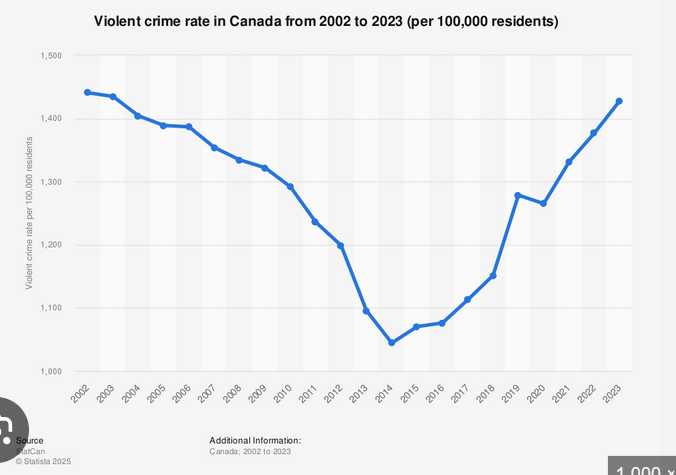
What has happened to our beautiful safe country?
Liberals, that's what
Foreign roving crime groups possibly responsible for dozens of home burglaries, say police
Criminal groups, possibly from Latin America and eastern Europe traveling between Canadian cities have been casing and burglarizing dozens of homes throughout the city, say Calgary Police.
Since the start of the year, at least 43 of the residential break-ins following a certain pattern have occurred in eight communities, with culprits usually seizing opportunities when homes are vacant in the early evening hours.
“In many of the incidents, suspects are believed to have accessed the homes through backyards, using them as primary entry points to remain out of view from streets and sidewalks,” city police said in a press release.
https://ca.news.yahoo.com/foreign-roving-crime-groups-possibly-220837693.html