
We are committed to sharing news, stories, events and opinions that ensures our province stays free, united and independent from the overreach of the Federal government.
All are welcome and respectful debate is encouraged. Please join with the intention of participating. Proceeds are donated.

In the next election (should the Libs even allow one) I will vote PC simply because I absolutely will not vote Liberal or NDP. I agree that a government under the CPC will not make a huge change as to how the west is treated but it will slow the destruction down a bit.
Our only option is to go independent.
Copied ⬇️
It has now been a year since Mark Carney became Prime Minister. He was elected largely on fear — fear of Donald Trump, fear of the United States, and the claim that he alone was capable of “handling” Trump. Yet the only thing his government has managed to do is irritate our closest ally. Now he is playing fast and loose with China, prompting threats from Trump of 100% tariffs on Canadian goods. If that were to happen, it would almost certainly trigger economic collapse in this country. That would not be diplomacy — it would be economic warfare against Canada.
And if I am asked to wager the future of my children and grandchildren, I will choose the United States over China every single time. Our shared history with America is long, complex, and strong. We are deeply integrated economically, culturally, and strategically. Gambling that relationship away for ideological posturing is reckless beyond measure.
Western alienation, however, did not begin with Carney, Trump, or China. It is nothing new. It has been part of Confederation from the very beginning. Even Clifford Sifton and Frederick Haultain understood this reality. Haultain travelled west and recommended that Saskatchewan and Alberta become a single province — recognizing that our interests, economies, and challenges were fundamentally different from those of Central Canada.
Since then, the West has endured a steady accumulation of slights — some subtle, many not. Pierre Trudeau’s National Energy Program devastated Western Canada and transferred billions of dollars out of Alberta and Saskatchewan. Brian Mulroney pulled the F-18 maintenance contract out of Winnipeg and handed it to Quebec. The GST was imposed. More recently, the carbon tax was layered on top of already struggling resource industries. Under Trudeau 2.0, we saw an oil tanker ban imposed off the West Coast and a federal government that openly stated its hostility toward oil and gas — the very lifeblood of Alberta and Saskatchewan.
This isn’t abstract to me. I have lived it.
I cut my political teeth in the Reform Party. Our early motto was simple and powerful: “The West wants in.” We promoted a Triple-E Senate, a reworking of equalization, and policies that would have strengthened the West while keeping Canada united. I went to Ottawa in late 1993 expecting to help make major structural changes to this country.
Reality hit hard.
In two federal elections, we elected exactly one Member of Parliament east of Manitoba. One. The truth became unavoidable. You cannot sell meaningful Senate reform, fairer equalization, or Western energy development to Central and Eastern Canada in numbers large enough to win power. In hindsight, we may well have been better off remaining a regional party, much like the Bloc Québécois. But we believed in Canada — more, it seems, than Canada believed in us.
Many people in Western Canada now say the Liberals must go. I agree. But would the West truly be better off under Pierre Poilievre? Look at history. Stephen Harper, in my opinion, led the best federal government in recent memory. He came from Reform roots. He understood Western grievances. And yet — where was Senate reform? Where was meaningful equalization reform? Where were secure pipelines to tidewater?
The answer is simple and uncomfortable. You cannot win or keep power in Canada by prioritizing Western interests. You need seats outside the West — lots of them. If a policy cannot be sold nationally, it will be sacrificed politically. That is the system. So if you believe a Poilievre government will suddenly fix all of the West’s problems, you probably also believe you can start a Boeing 777 with a flashlight battery.
Let me be very clear that under our current system of Confederation, there will be no fundamental change of any consequence.
Which brings us to the question we can no longer avoid — what is the solution?
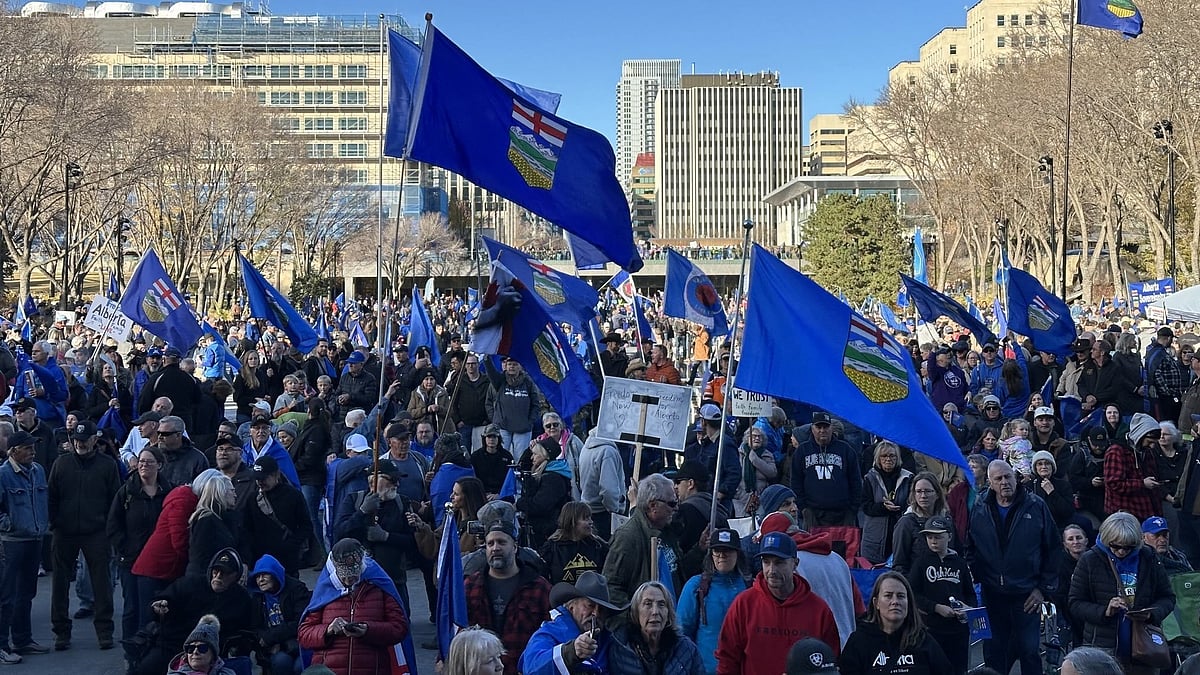
I am watching with great interest the movement in Alberta to force a referendum on independence. Do I think such a referendum would pass today? Probably not. But that is not the point. At the very least, it puts the question squarely on the table and forces an honest national conversation — something Ottawa has avoided for decades.
I am hopeful a similar movement will flourish in Saskatchewan.
Predictably, those pushing for a referendum are being branded as a fringe group or dismissed as “rednecks.” Ironically, that is exactly how Reformers were branded when we began. Now we hear at least one provincial premier calling Albertans “traitors.” That language is astonishing. When Quebec held its referendums, no one called Quebecers “traitors.” The entire country wrapped itself in a group hug and begged Quebec to stay.
When Alberta asks the same question, it is vilified.
If you believe the numbers lining up to sign Alberta’s referendum petition, this is clearly not a fringe movement. As for the “redneck” label — let me put it plainly. If being a redneck means I want genuine autonomy for my province, meaningful Senate reform, a fair equalization formula, and respect for the industries that feed this country, then yes — I am a redneck.
And if all of those options fail — as they have, repeatedly, since Confederation — then we must seriously consider independence. Call me a redneck if you like. In fact, put me at the top of the list.
I remain steadfast that I have never been seeking independence from Confederation — but I was absolutely seeking independence from Ottawa. After decades of failure, perhaps it is time to admit that those two things may no longer be separable.
Allan Kerpan served two terms as a Reform Party MP and later completed two terms as a Saskatchewan Party MLA.
https://www.westernstandard.news/opinion/kerpan-a-case-for-alberta-independence/71066